Educational approach
Learning makes connections.
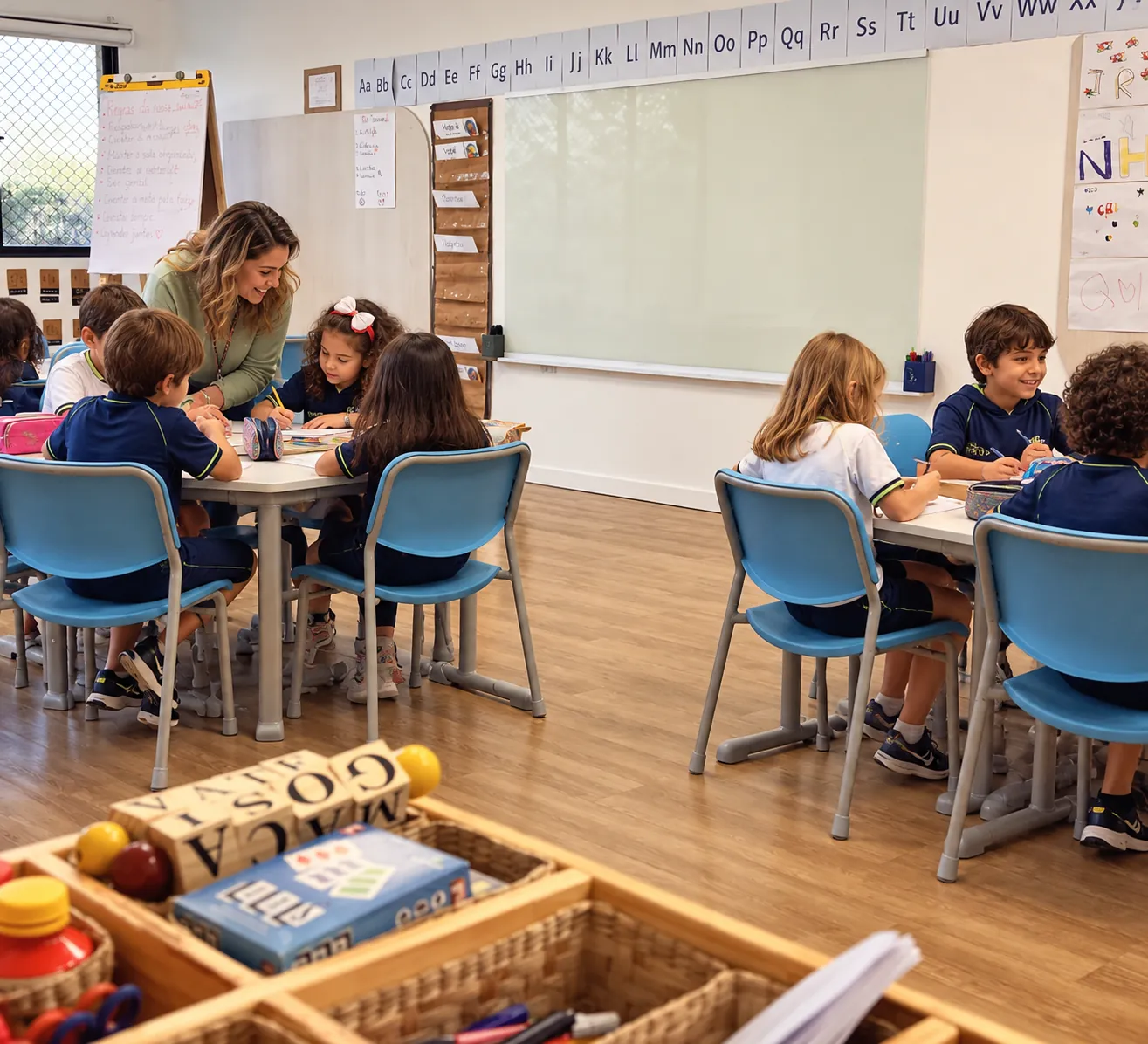
A social constructivist approach with the student at the centre. Students ask, investigate, create and share, in English and Portuguese.
Bilingual learning
Two languages. Many ways to learn.
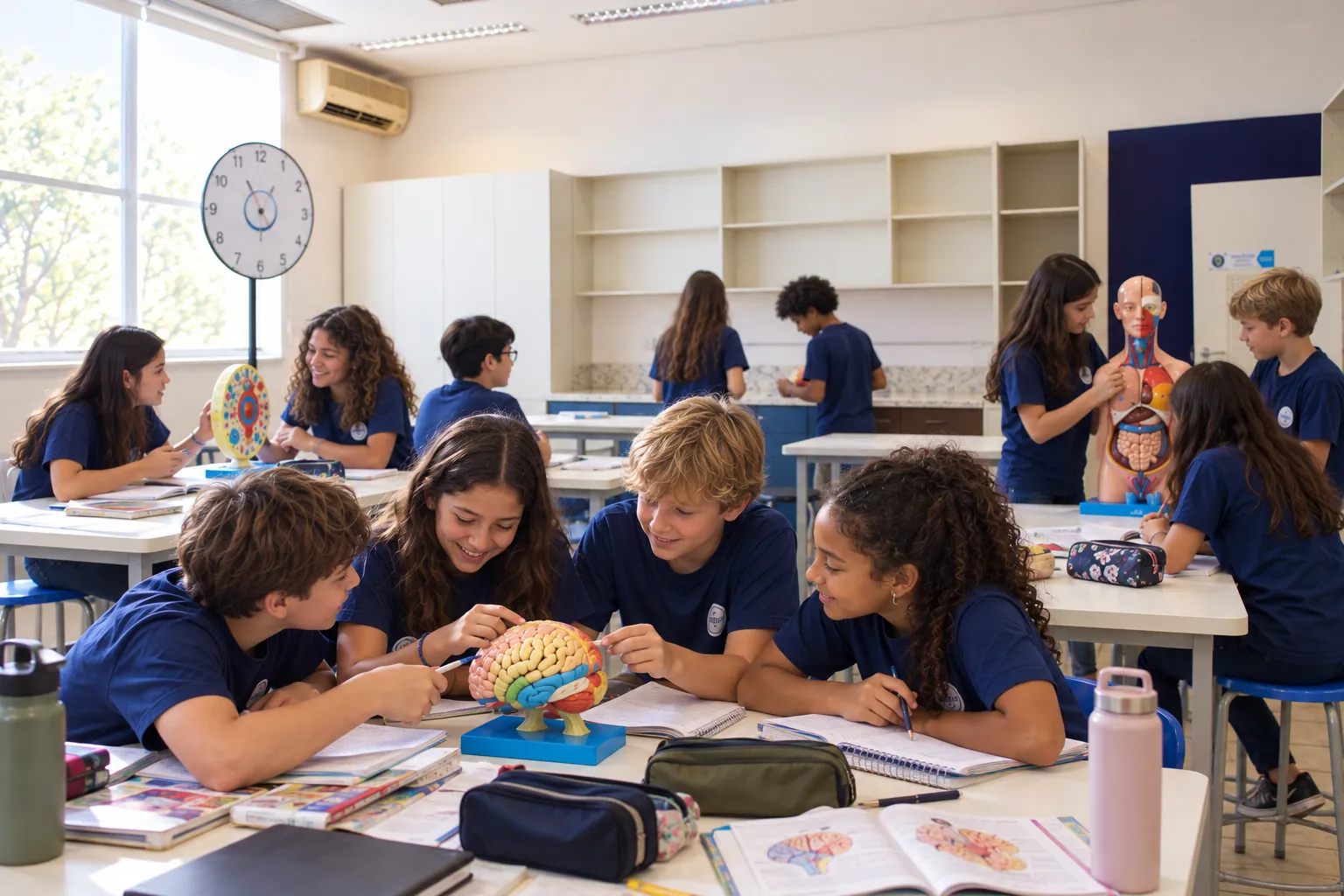
At Sphere, English is not just another lesson. English and Portuguese are both languages of instruction, and content is learned through both.

Educational approach
The inquiry cycle
The inquiry cycle is the student’s learning process!
- Tuning in
- Finding out
- Sorting out
- Going further
- Making conclusions
- Taking action
Reflecting on personal understanding
At Sphere International School, we offer a unique educational journey that combines academic excellence, social-emotional development and citizenship education. Our approach stands out for a solid curriculum, inspired by the BNCC (Brazilian educational framework) and enriched by an international perspective, preparing students for a global future while still valuing local principles and culture.
The inquiry cycle is a teaching strategy developed and recognised in different educational contexts around the world as an approach that supports academic quality. Across our Units of Inquiry, we lead discussions, guide research, and pose and answer questions, always letting students lead the process and build their knowledge securely and consistently.
With a full-day schedule, we ensure quality time for deepening knowledge and developing essential skills. The Sphere Profile – Global Citizenship guides this whole process, strengthening essential 21st-century competencies and preparing our students to be agents of change anywhere in the world.
Our curriculum values learning based on concepts and on interdisciplinary and transdisciplinary projects, with an emphasis on personalisation and on the student at the centre. From the early years, we offer meaningful immersion in English, while intentionally integrating expressive areas such as Arts, Music and Physical Education in Portuguese, preserving and valuing the local culture and the mother tongue.
We promote social-emotional development across the curriculum from Early Childhood and encourage social and environmental engagement through projects, as well as respect for diversity. In this way, we educate aware, responsible citizens who are committed to their communities.
At Sphere, we educate for a rapidly changing world: human, global and sustainable.
Final result: Well-rounded students!
The goal of the Sphere International School educational approach is to develop young leaders who will make a difference in the world, whatever path they choose.
The Sphere Way
The profile of a Sphere learner.
Ten attributes guide teaching practice and student development at every stage.
- Agentic
- Collaborative
- Good communicators
- Culturally aware
- Curious
- Empathetic
- Ethical
- Problem-solvers
- Reflective
- Open-minded
Curriculum
Academic rigour, from Brazil to the world.
The curriculum integrates the Brazilian national curriculum (BNCC) with the international frameworks of IB programmes. To follow learning closely, the school sets its own assessments in every subject area.
Foundations
- BNCCThe Brazilian national curriculum guides the national programme.
- IB · PYP and MYPInternational Baccalaureate programmes guide the international curriculum.
- UNESCOThe four pillars of education and the Sustainable Development Goals inspire projects in every year group.
UNESCO's four pillars of education
- Learning to know
- Learning to do
- Learning to be
- Learning to live together
Academic goals
Sphere Granja Viana works so that every student is able to:
- Take responsibility
For themselves and their own learning, making choices, acting and reflecting on their actions.
- Relate to others
And to the environment, respectfully and collaboratively.
- Develop logical reasoning
And calculate using personal, innovative and conventional strategies.
- Read, interpret and create
Critically produce different kinds of text, with clarity, coherence and awareness of context and audience.
- Understand, use and create technology
Digital information and communication technologies, used ethically, meaningfully, critically and reflectively.
- Express themselves
Orally, with clarity and confidence, using multiple forms of expression.
- Develop an inquiring mind
Attitudes and strategies of scientific inquiry across every field of knowledge.
Proficiency certificate
- Cambridge EnglishInternationally recognised English exams from Year 3.
Technology in the service of learning
Classrooms with interactive whiteboards, tablets and Chromebooks, plus the Design Lab, built for technology and Design Thinking projects.
Assessment
Continuous follow-up, no exam weeks.
Assessment is introduced gradually from Year 2. Throughout each term, teachers observe, set assessment activities and adjust course.
- Tests exist, but they are one step among many and can take different forms, such as open-book tests that teach students to research and build answers.
- With visible learning, teachers observe children's thinking in action and make the learning process clear to them.
- The aim is to learn to study continuously, without linking knowledge to moments of pressure.
School-wide projects
Values put into practice.
Ongoing projects connected to student agency, sustainability, cultural diversity and social responsibility.
-
Book Club
Encourages reading in English, in Portuguese and in each student's mother tongue.
-
Assembly
Class assemblies every two weeks to listen, take a position and find shared solutions.
-
Sphere Cares
Social action that builds awareness of everyone's part in changing the world around them.
-
Recycling for Fun
Ongoing collection of recyclable materials, reused in school projects.
Educators
Those who teach keep learning.
Valuing teachers is one of the pillars of our approach. Sphere's teacher development programme includes:
- Induction for new teachers
- Weekly meetings by year group and by stage
- Weekly time for collaborative planning
- Dedicated training in January and July
- National and international workshops and conferences
Families
Learning is a relationship.
Families take part in school life, not just from the audience. At the Student-Led Conference, instead of hearing the school talk about their child, families listen to the student present their work, achievements, challenges and goals.
-
Student-Led Conference
Students prepare and present their learning journey to their parents.
-
Special Saturdays
Saturdays on the calendar with Family Day, Book Fair, Festa Junina, STEAM Festival and International Party.
-
Meetings and talks
A meeting at the start of the school year, further meetings at the end of the first and second terms, and talks throughout the year.
-
Talent bank
Parents and relatives share their knowledge in everyday school life.
What has your child been discovering?
Bring that story to our conversation.
Book a visit
Explore our approach in person.
Talk to our team about learning, bilingual education and the stages of school life.